1

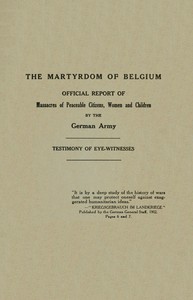
The Martyrdom of Belgium Official Report of Massacres of Peaceable Citizens, Women and Children by The German Army — Story, Setting & Ideas
(0 User reviews)
448
Project Gutenberg
2016
Not confirmed
World War, 1914-1918 -- Atrocities
Readers of public-domain and historical texts
Project Gutenberg digital edition
en
Edition facts
Words
12,052
Reading time
53 min
Text sections
5
Before opening The Martyrdom of Belgium Official Report of Massacres of Peaceable Citizens, Women and Children by The German Army — Story, Setting & Ideas, the edition data offers a quick orientation: 12,052 words, 53 min estimated reading time, and 5 detected text sections.
The text analysis averages about 20.5 words per sentence, while the detected sections provide another way to judge how the source is divided.
Project Gutenberg metadata also associates the work with “World War, 1914-1918 -- Atrocities,” connecting these edition facts with the source record’s subject description.
Source:
Project Gutenberg record #53636
Gerard Cooreman's preface frames the Belgian Commission of Inquiry's eleventh report, presenting witness depositions of German atrocities in 1914. The text shifts from legalistic justification to stark, chronological accounts of village massacres, church profanations, and mass executions, with a notable change in pace as individual testimonies accumulate.
Editorial Edition Score
4.5/5
★★★★★
★★★★★
Calculated from edition completeness, EPUB availability, text structure and catalogue metadata. Not a user rating.
How this score is calculated
- Description quality20 pts
- Title & short description10 pts
- Source metadata20 pts
- Text length15 pts
- Chapters / structure15 pts
- EPUB file integrity20 pts
Total of 100 points, scaled to a 2.5-5.0 range. Editions with an empty description or a missing EPUB file are not scored.
Edition quality
Public-domain source text
Read the source text
The source text is kept in the dedicated reader, separate from this catalogue record and its commentary.
The preface by Gerard Cooreman establishes a dual frame: legal authority and moral outrage. The Commission, composed of “Statesmen and Jurists of the highest standing,” vouches for the depositions, while Cooreman contrasts the “tragic eloquence” of the testimonies with the German General Staff’s own 1902 manual, quoted to argue that the atrocities were “an organized system of terrorism.” This opening sets a measured, documentary tone before the reports descend into raw, unadorned witness accounts.
From Legal Frame to Witness Voice
The transition from preface to testimony is abrupt. Cooreman’s prose is formal and argumentative, but the depositions that follow adopt a flat, chronological style: “Next they went to the farm of Jules Rifon, took him out of his cellar… and shot him.” The shift in register is striking—the Commission’s institutional language gives way to a catalogue of specific names, ages, and locations. Witnesses report events in sequence, often noting precise times (“August 24th, 1914, at about 5.30 in the afternoon”). This plainness amplifies the horror; the lack of rhetorical embellishment makes each detail feel unmediated. The narrative pace quickens as one village account follows another, with minimal transition, creating an accumulating weight of incident.
Recurring Patterns in the Depositions
Several motifs recur across the excerpts. Churches are consistently profaned: at Hastiere, horses were stabled inside, vestments torn, and relics scattered—including “relics of the Eleven Thousand Virgins of Cologne, which had escaped the fury of the Huguenots of 1590.” Civilians are shot after being separated from women, often following a summary accusation. The phrase “the men and the women were separated” appears repeatedly. Witnesses note the ages of victims—an 88-year-old choirman, an 80-year-old step-mother, a 16-year-old son—underscoring the indiscriminate nature of the killings. The depositions also record acts of arson and looting as routine: “the place was then sacked, and the greater part of the houses burned.” These patterns, reported without commentary, build a cumulative case for systematic violence.
Pace and Accumulation of Detail
The report’s structure creates a relentless rhythm. Each paragraph typically covers a single village or incident, moving from one to the next with little connective tissue. The effect is a staccato list of horrors: at Surice, “the old choirman, Charles Colot, aged 88, was shot as he came out of his door”; at Fosses, eighteen men are lined up and executed after an officer declares, “You all deserve to be shot.” The pace never slows; there are no reflective pauses. This accumulation of specific, unadorned testimony—names, ages, locations, times—serves the Commission’s evidentiary purpose. The reader is given no respite, mirroring the relentless nature of the events described. The final pages of the excerpt revert to Project Gutenberg boilerplate, a jarring shift from the narrative intensity.
Readers should attend to the tension between the preface’s legal framing and the depositions’ stark simplicity. The Commission’s insistence on authenticity—names withheld to protect witnesses—adds a layer of historical contingency. The report is not a continuous narrative but a dossier; its power lies in the accumulation of discrete, verifiable details. Approach it as documentary evidence shaped by its moment, a text that uses bureaucratic form to bear witness to atrocity.
After all these years, the Belgian depositions still weigh on me—those quiet lists of names, the orderly horror. Yet beside them I keep Germany before the war — Text and Context, a gentler voice speaking of striving and ambition, unaware of the gathering storm. Their kinship is a trembling, terrible one: the shy hope before, the shattering after.
There are no reviews for this eBook.
There are no comments for this eBook.
Reader reflection
What did you think of this book?
Answer a few questions and save a private reflection on this device.
Your progress
0
/
10
2
How did the book work for you overall?
3
How likely are you to recommend this book?
4
Did the language feel accessible?
5
Could you see yourself revisiting this book?
6
Did you relate to its people, ideas, or situations?
7
How useful were the ideas in this book?
8
How much did the book move you?
9
In one sentence, what did you learn?
10