1

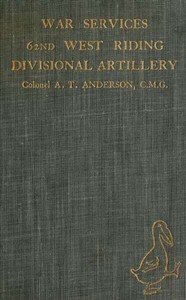
War Services of the 62nd West Riding Divisional Artillery — Inside the Classic
6
1
Project Gutenberg
2015
World War, 1914-1918 -- Regimental histories -- Great Britain; Great Britain. Army. Division, 62nd
Readers of public-domain and historical texts
Project Gutenberg digital edition
en
Edition facts
Words: 41,582
Reading time: 181 min
Text sections: 8
Source:
Project Gutenberg record #50066
Colonel A. T. Anderson's unit history of the 62nd West Riding Divisional Artillery from 1917 to 1919, based on official records and personal observation. The narrative focuses on specific engagements, the effects of gas warfare, and the resilience of Yorkshire Territorial gunners under sustained German offensives.
Editorial Edition Score
4.7/5
★★★★★
★★★★★
Calculated from edition completeness, EPUB availability, text structure and catalogue metadata. Not a user rating.
Edition quality
Colonel A. T. Anderson, who commanded the 62nd Divisional Artillery from 1916 to 1919, opens his account in January 1917, deliberately omitting the unit's formation and training. The preface by Lieutenant-General Sir Walter Braithwaite supplies that missing context, noting that Anderson and his brigade-major took over a division then at Salisbury Plain and shaped it into a reliable instrument. Braithwaite credits three qualities—grit, discipline, and co-operation—and stresses that the artillery existed to help the infantry, a bond the narrative repeatedly tests.
Gas and Endurance at Les Essarts
The German offensive of March 1918 provides the book's most sustained ordeal. Anderson describes how the 312th Brigade, positioned along a hedge near Les Essarts, was deluged with mustard gas shells. The batteries kept firing on call, but the human cost was severe: gunners' hands blistered, many temporarily blinded. C/312 battery effectively ceased to exist as a fighting unit by evening, all six officers wounded or gassed. Major Crofton, the battery commander, had already been wounded several times and missed promotion—twice, once in Mesopotamia—because wounds arrived on the day of his appointment. The narrative records precise casualty lists and round counts: D/312 fired 2,600 rounds under heavy gas bombardment, earning Major Swain a Military Cross.
The Commander-in-Chief's Order and the Mood of March 1918
Amid the relentless attacks, Anderson reproduces the full text of a stirring order issued by the Commander-in-Chief on 11 April 1918. The order acknowledges that troops are tired, asserts that victory belongs to the side that holds out longest, and promises French support. Anderson's own commentary frames this document as confirming a resolution already taken: to hold back the enemy as long as a gun or rifle remained. He notes that the first three weeks of the great offensive felt like months of constant danger, anxiety, and utter fatigue. The juxtaposition of official rhetoric and the exhausted reality of the gunners creates a tension between command optimism and frontline experience.
Structure and Omissions: What the Record Leaves Out
Anderson's account is strictly chronological, with chapters titled by phase: The First Advance, Trench Warfare, The Battle of Cambrai, The Great German Offensive, With the 5th French Army, The Final Triumph, and The Last Phase. Appendices list officers, decorations, and subsequent service of the 311th Brigade. Yet the preface reveals a deliberate gap: Anderson says nothing about how the artillery came to its standard of excellence before 1917. The narrative focuses on operations, not personalities or training. Casualties are enumerated in lists, not lingered upon. The book's tone is factual, almost terse, with moments of understated sympathy—'much sympathy was felt for the gallant Battery Commander'—that hint at emotion beneath the official surface.
Readers should approach this volume as a primary document of unit experience rather than a comprehensive history. Anderson's perspective as the commanding officer shapes what is included and what is passed over. The appendices offer raw data for those tracing individual officers or decorations. For understanding how a Territorial artillery division endured the 1918 German offensives, the narrative provides specific, unadorned testimony.
Reader reflection
How will you remember this book?
Save your reaction, strongest insight, and memorable passage.
Your progress
0
/
10
2
How did the book work for you overall?
3
Is this a title you would suggest to others?
4
Did the language feel accessible?
5
Was the book what you thought it would be?
6
Did the book give you something worth debating?
7
Would you read this book again?
8
How clearly were the main ideas presented?
9
In one sentence, what did you learn?
10