1

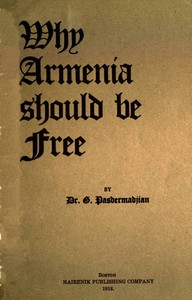
Why Armenia Should Be Free: Armenia's Rôle in the Present War — Context and Discussion
13
1
Project Gutenberg
2017
World War, 1914-1918 -- Armenia
Readers of public-domain and historical texts
Project Gutenberg digital edition
en
Edition facts
Words: 19,293
Reading time: 84 min
Text sections: 3
Source:
Project Gutenberg record #53976
A 1918 wartime argument by Armenian leader Dr. G. Pasdermadjian (Armen Garo) detailing Armenian military contributions on the Caucasian front and exposing Russian imperial policy, framed by a translator's preface and an introduction by George Nasmyth.
Editorial Edition Score
4.5/5
★★★★★
★★★★★
Calculated from edition completeness, EPUB availability, text structure and catalogue metadata. Not a user rating.
Edition quality
Dr. G. Pasdermadjian, writing under his nom de guerre Armen Garo, opens this 1918 polemic with a direct appeal to Allied war aims, positioning Armenian independence as a test of the war's moral outcome. The book's structure moves from a translator's preface through a series of evidence-laden chapters, each built around specific military engagements and diplomatic betrayals. Pasdermadjian's voice is that of a participant—former deputy from Erzeroum in the Ottoman parliament and commander of Armenian volunteers—giving the text an insider's urgency. The prose shifts between measured historical exposition and sharp indictment, particularly when recounting Russian czarist policy. George Nasmyth's introduction frames the argument within the broader League of Free Nations movement, while Aram Torossian's translation preserves the original's declarative tone. The work is less a comprehensive history than a targeted brief, marshaling facts to support a single political claim.
A Voice from the Front Lines
Pasdermadjian writes not as a detached historian but as a former commander of the Second Battalion of Armenian Volunteers on the Caucasian front. This experiential authority shapes the book's most vivid passages, particularly the account of General Abatzieff's orders in December 1914. The author describes how the Russian general forbade 32,000 Armenian civilians from fleeing advancing Turkish forces, placing Cossack patrols to enforce the order, while the Russian army itself retreated. The detail of the Armenian volunteers learning of this only after returning from frontline duty—having fought for two months under the same general—creates a stark contrast between Armenian sacrifice and Russian indifference. Pasdermadjian's narrative voice here is controlled but damning, letting the sequence of events speak for itself. He avoids rhetorical flourishes, instead building his case through specific dates, troop movements, and named commanders. The effect is that of a military report repurposed for political advocacy, lending the account a documentary weight that purely emotional appeals would lack.
The Lobanoff Policy in Practice
A central thread in Pasdermadjian's argument is the exposure of what he calls the 'Lobanoff-policy'—named after the Russian foreign minister who reportedly said, 'We need Armenia, but without the Armenians.' The book devotes considerable space to demonstrating how this principle guided Russian actions throughout the war. Pasdermadjian notes that Russian official communiqués never mentioned Armenian volunteer battalions, even when those battalions saved the army's right and left wings from catastrophe in 1914-1915. He further points out that the Russian press was forbidden to report on Turkish massacres of Armenians. The disbanding of Armenian volunteer battalions after the capture of Erzeroum in 1916, ordered by Grand Duke Nicolas Nicolaevitch, is presented as the logical outcome of a consistent policy. The author also observes that before the war, Russian authorities removed Armenian officers from the Caucasus and replaced them with officers from other ethnic groups, a move he interprets as designed to check Armenian national aspirations. These observations are woven into a pattern of systematic erasure, where Armenian military contributions were simultaneously exploited and denied.
Structure as Argument
The book's organization reflects its polemical purpose. After the introduction and translator's preface, the chapters proceed chronologically and thematically: Turkish and Russian proposals to Armenians in 1914, military services on the Caucasian front, Armenian resistance to massacres, Russian czarist attitudes, the post-collapse role in the Caucasus, and cooperation with Allies on other fronts. Each chapter functions as a discrete piece of evidence, building toward the conclusion that Armenian independence is both deserved and strategically necessary. The translator's preface, written by Aram Torossian, adds another layer of mediation, suggesting the text's journey from Armenian to English readership. The inclusion of the author's full credentials on the title page—ex-deputy, former commander, representative of the Armenian National Council—serves to authenticate the narrative. This careful framing indicates that the book was designed not merely to inform but to persuade an American and Allied audience at a critical moment in wartime diplomacy.
Readers should approach this text as a primary source from a key Armenian political figure during World War I, rather than as an objective history. The book's value lies in its firsthand perspective on Russian-Armenian relations and its documentation of specific military events often omitted from official accounts. Pay attention to the dates and places mentioned—Sarikamish, Van, Erzeroum—and consider how the author's position shapes what he emphasizes and what he omits. The introduction by George Nasmyth provides a useful window into how the Armenian cause was framed for an American audience invested in the League of Nations idea.
Reader reflection
How did this book work for you?
Your answers remain private and are stored only in this browser.
Your progress
0
/
10
2
How much did you enjoy the reading experience?
3
How likely are you to recommend this book?
4
How much effort did this book require?
5
Would you like to discuss this book with someone?
6
Do you expect to return to this book?
7
How did the pace of the book feel?
8
How understandable was the text?
9
What did this book teach you most?
10